1. Complete commissioned survey
The Handley Partnership plans and carries out the survey, prepares the HAABase records, applies the assessment methodology, analyses the results and produces the agreed outputs.
Buildings at Risk and Heritage at Risk surveys
The Handley Partnership delivers Buildings at Risk surveys, listed building condition assessments, survey training, analysis and reporting, supported by the HAABase heritage data system.
Overview
The Handley Partnership undertakes Buildings at Risk surveys, Heritage at Risk surveys and listed building condition assessments for local authorities, national heritage bodies and other organisations responsible for historic assets.
Many organisations begin with a practical need: to understand which buildings or heritage assets are at risk, how serious that risk is, what evidence supports the assessment, and what should happen next.
HAABase has been developed for that purpose. It is a complete survey, database, analysis and reporting system for Heritage at Risk work, listed building condition assessment and wider historic environment monitoring. It can be used to deliver a full commissioned survey, to support trained in-house surveyors, or to manage ongoing updates after the main survey has been completed.
The Handley Partnership can carry out the survey work directly, provide the HAABase database and analysis service, train client surveyors to use the method, or support a combined approach where local knowledge, officer input and specialist assessment are brought together in one structured system.
How we can help
The Handley Partnership is one of the UK’s leading specialist consultants in Heritage at Risk survey, listed building condition assessment and structured heritage asset analysis. HAABase brings that long-term field experience into a practical system that can be used by local authorities, national heritage bodies, estate managers, trusts and community heritage organisations.
The service can be scaled to suit the client. For some projects, The Handley Partnership undertakes the full survey, creates and manages the HAABase database, analyses the results and produces the final reports. For others, we provide the method, training, database and quality review so that the client’s own officers, consultants or volunteers can carry out the survey work consistently.
Once established, HAABase is not a static record. Approved users can provide ongoing updates as required, allowing changes in condition, occupancy, risk, repair, ownership, vulnerability or priority to be recorded over time.
Flexible service models
The Handley Partnership plans and carries out the survey, prepares the HAABase records, applies the assessment methodology, analyses the results and produces the agreed outputs.
We can train local authority officers, consultants, volunteers or partner organisations to use the HAABase survey method, recording standards, photographic approach and assessment process.
HAABase provides the structured database, scoring, search, mapping, reporting, prioritised action lists and update tools needed to keep survey evidence useful after the first inspection cycle.
Scale and experience
The Handley Partnership’s listed building condition work began with authority-level Buildings at Risk surveys and developed into large-scale, repeatable survey programmes across the UK.
In Wales, this experience grew from local authority commissions into the all-Wales listed building condition review commissioned by Cadw, creating a consistent national evidence base for the condition and risk status of listed buildings.
The same structured approach has also been applied in many parts of England and introduced internationally through heritage building survey work in Winnipeg, Canada. HAABase is therefore suitable for individual authorities, regional partnerships, national heritage bodies and international heritage asset programmes.
Where HAABase can be used
HAABase is often used for listed building condition surveys and Buildings at Risk work, but the system is not limited to listed buildings. It can be adapted for scheduled monuments, conservation area assets, industrial heritage, locally listed buildings, estate heritage, public realm features, archaeological structures and other historic environment assets.
This makes it suitable where a client needs consistent evidence across a mixed heritage asset base, especially where condition, vulnerability, risk and priority need to be compared across different asset types.
Authority-wide listed building condition surveys, Buildings at Risk registers and repeat update cycles.
Structured assessment of monuments, ruins, industrial structures, archaeological remains and other heritage assets.
Rolling condition reviews using a consistent methodology across multiple areas, partners or administrations.
Prioritised evidence for repair programmes, scarce-resource targeting, intervention strategies and funding bids.
Stock profiling, vulnerability mapping, performance indicators and long-term condition trend analysis.
Approved users can update records as new evidence, repairs, deterioration or changes in use are identified.
Rapid external inspection records condition, occupancy, use, vulnerability and other indicators, supported by a long-established Buildings at Risk methodology.
The Heritage Asset Assessment score combines element condition, relative importance and occupancy to produce a more sensitive measure of condition and risk.
Historic survey cycles and user updates allow deterioration, improvement and emerging vulnerability to be analysed over time rather than judged from a single inspection.
Additional models can consider heritage crime risk, building type, use, location and other indicators to identify assets and areas requiring attention.
Climate-related vulnerability can be assessed by combining survey data with exposure, weather, soil and flood-risk information where relevant.
Risk, HAA score, list grade, decline models and local priorities can be combined to produce clear, ranked action lists for scarce resources.
Project lifecycle
Survey scope, base data collection, list-entry separation, GIS preparation, field definitions, scoring method and creation of individual HAABase records.
THP can carry out the fieldwork directly, train client surveyors to use the HAABase method, or support a joint delivery model with quality review.
Survey upload, validation, scoring, risk modelling, reporting, user training, ongoing updates and operational support.
Survey method
HAABase survey work is based on consistent visual assessment, normally by rapid external inspection from public places. Where private land access is needed, consent is sought before any data collection or photography is carried out.
Digital tablet forms use mapping, structured fields and validation so that evidence is collected consistently before a record is finalised. Photographs are handled carefully, with sensitive details excluded or blurred where appropriate.
Training and quality control
Where clients wish to use their own officers, consultants or volunteers, The Handley Partnership can provide training in the HAABase survey method, risk categories, field definitions, photographic approach, update process and database workflow.
This allows local survey capacity and local knowledge to be used while maintaining a consistent evidence standard across the whole project.
Database and system outputs
Approved users can search by text, filter by group, view results as lists or maps, access asset detail pages, generate reports, and analyse defined subsets by condition, risk, HAA score, defect profile, vulnerability and action priority.
Secure user access, controlled updates and API options allow client datasets to be maintained while protecting the integrity of the core records.
Ongoing updates
HAABase can remain in use after the initial survey. Client users can add updates as required, recording changes in condition, repair progress, occupancy, ownership, photographs, risk status, priority and action notes.
This makes HAABase especially useful for authorities and heritage bodies that need to monitor change, report progress, plan interventions and maintain an evidence base over several years.
System examples
HAABase combines structured survey records, mapping, risk assessment, condition analysis and prioritised action reporting in a secure web-based system. The examples below use anonymised demonstration content based on real system views.
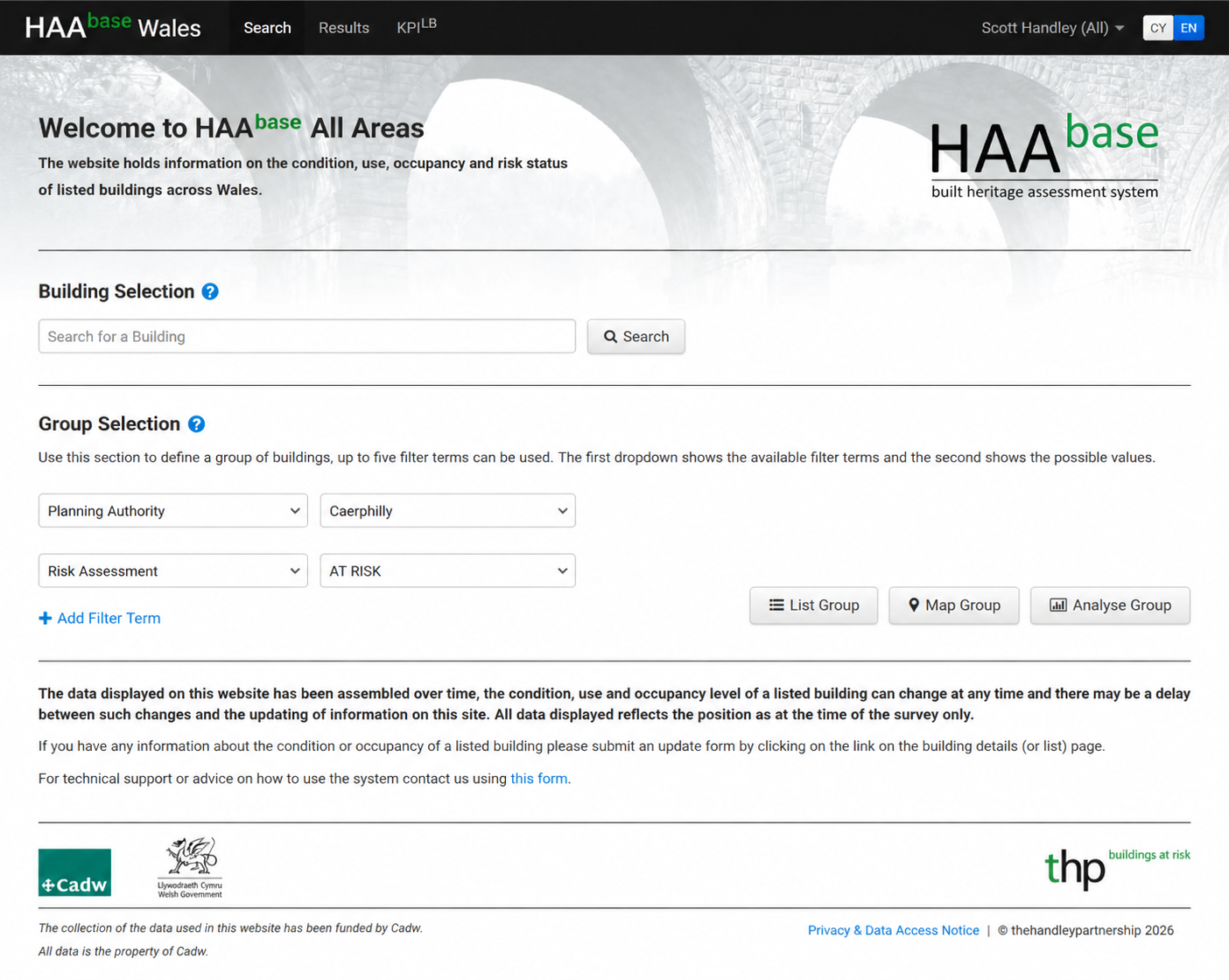 Search and filtering
Define groups of heritage assets by authority, area, risk and condition.
Search and filtering
Define groups of heritage assets by authority, area, risk and condition.
 Results list
Review matching records with condition, HAA score and priority indicators.
Results list
Review matching records with condition, HAA score and priority indicators.
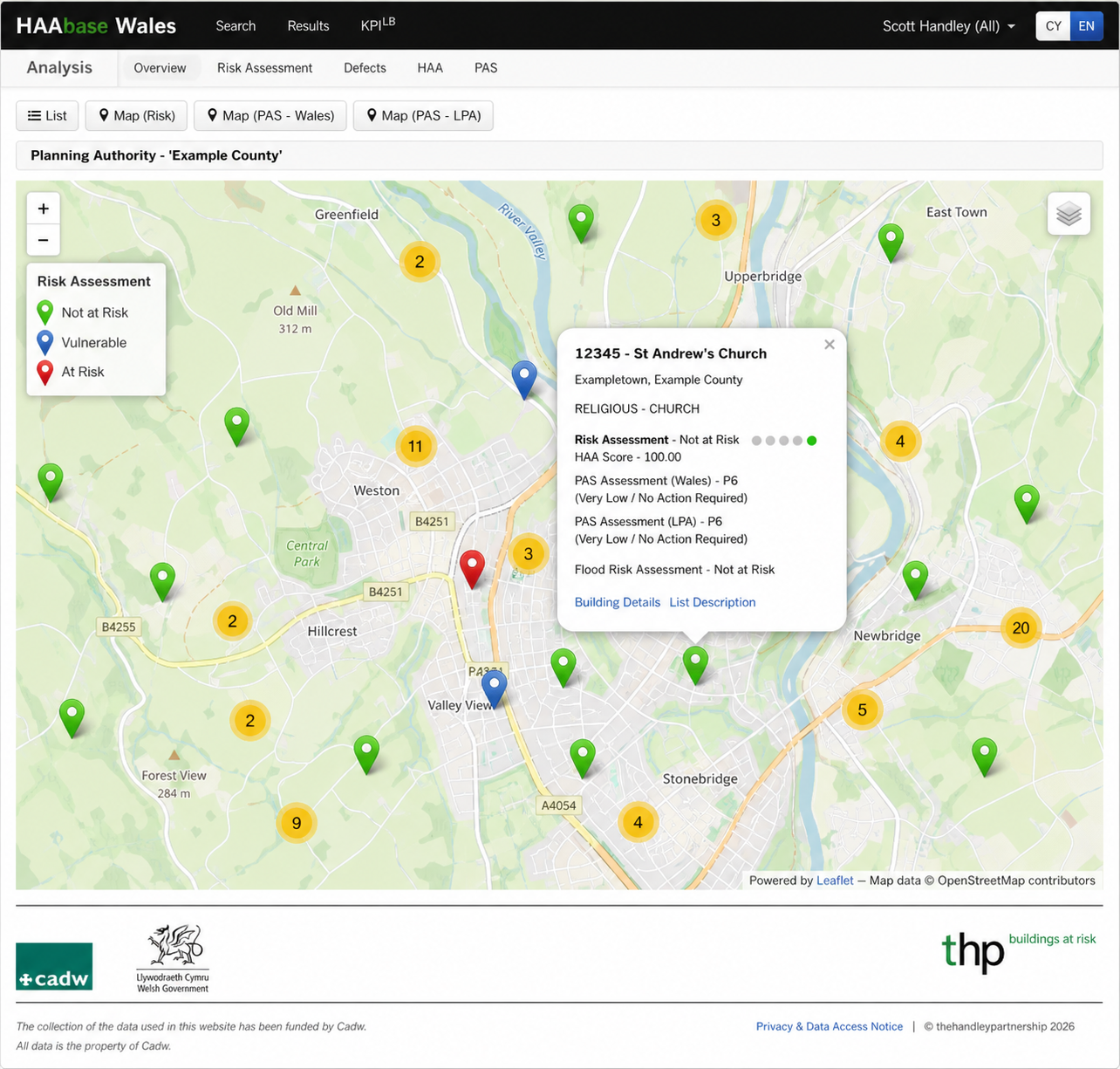 Map view
Visualise risk, priority categories, clusters and selected records spatially.
Map view
Visualise risk, priority categories, clusters and selected records spatially.
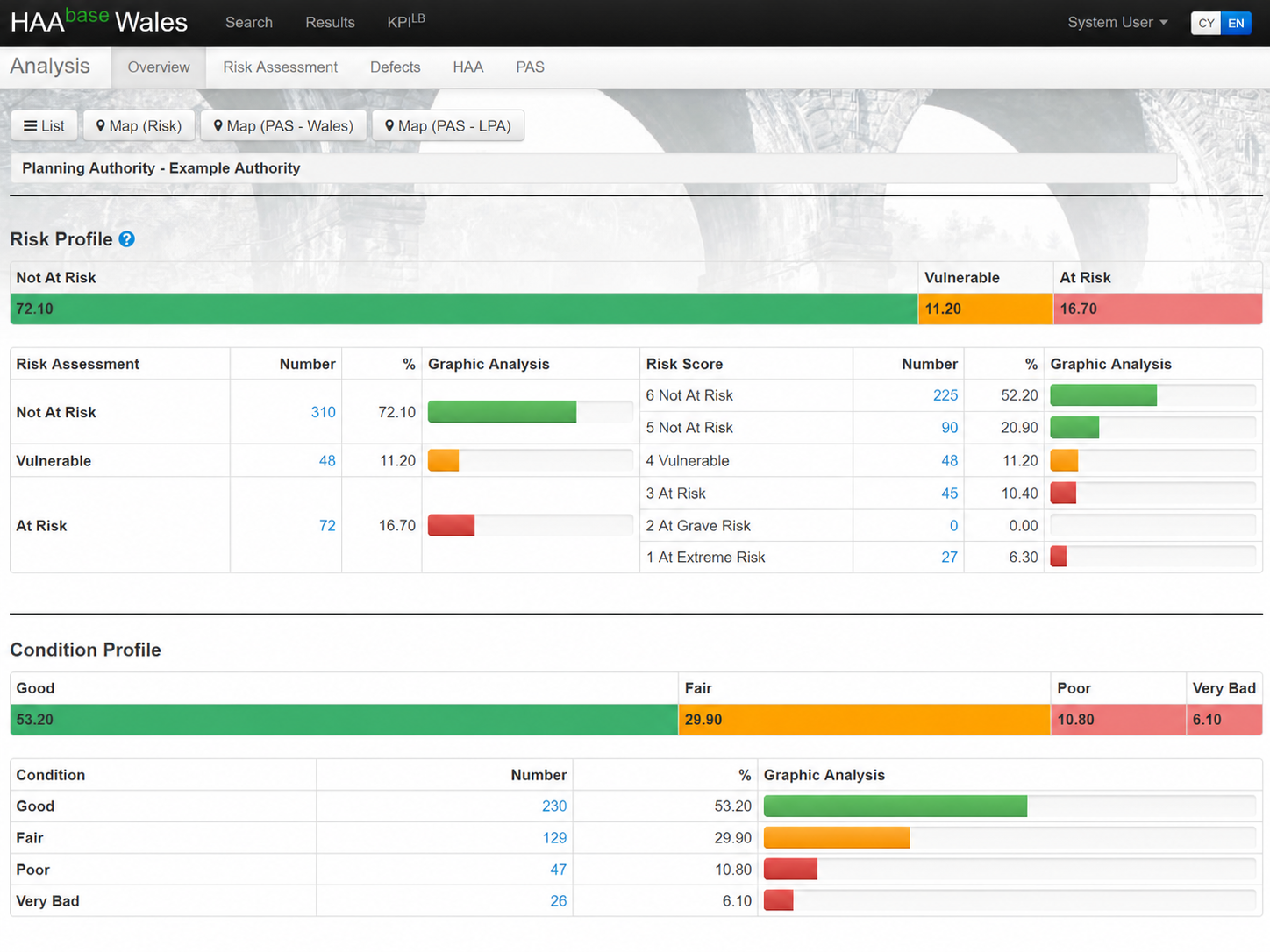
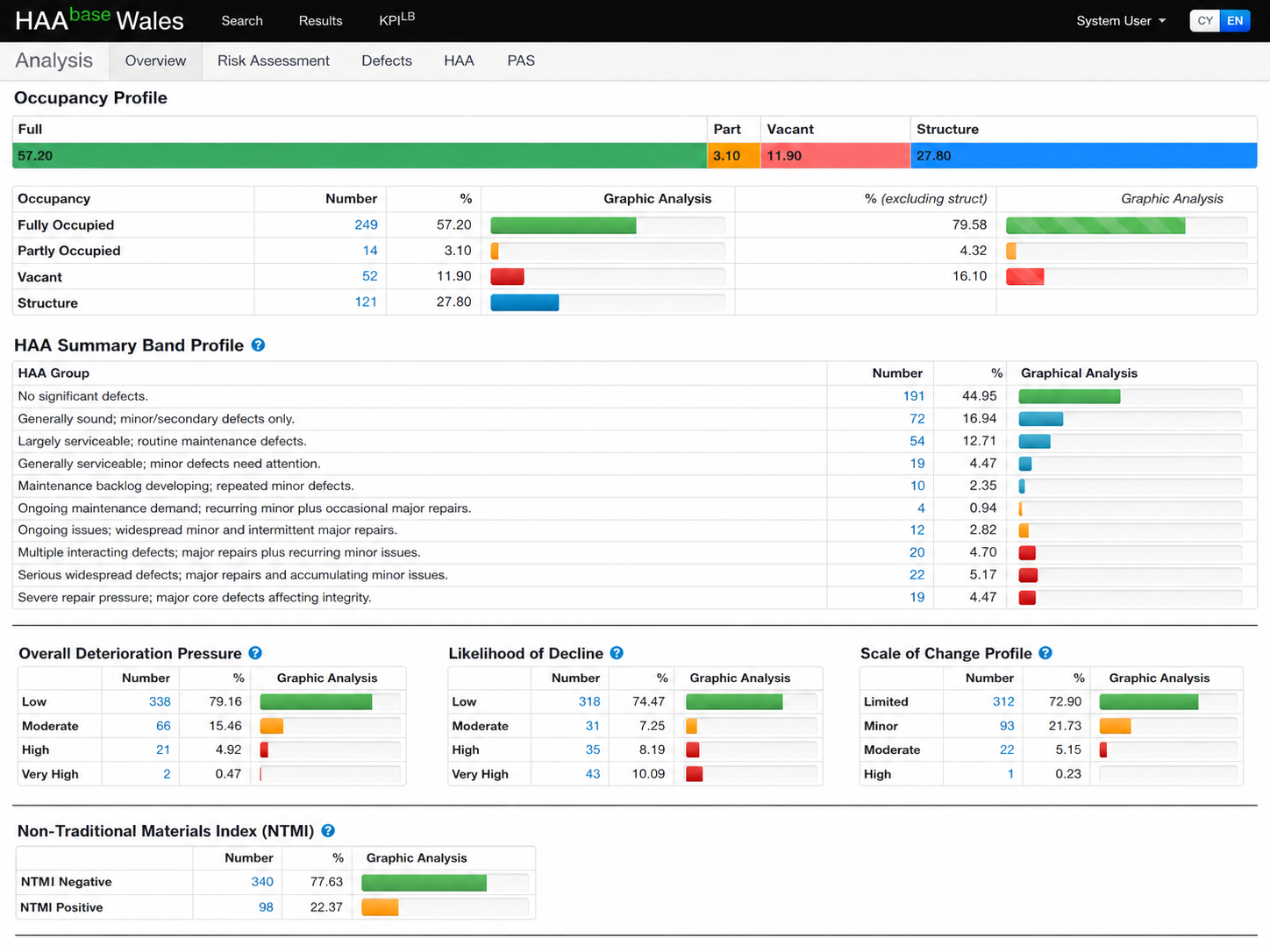 Analysis dashboard
Summarise risk, condition, occupancy and HAA profiles across a study area.
Analysis dashboard
Summarise risk, condition, occupancy and HAA profiles across a study area.
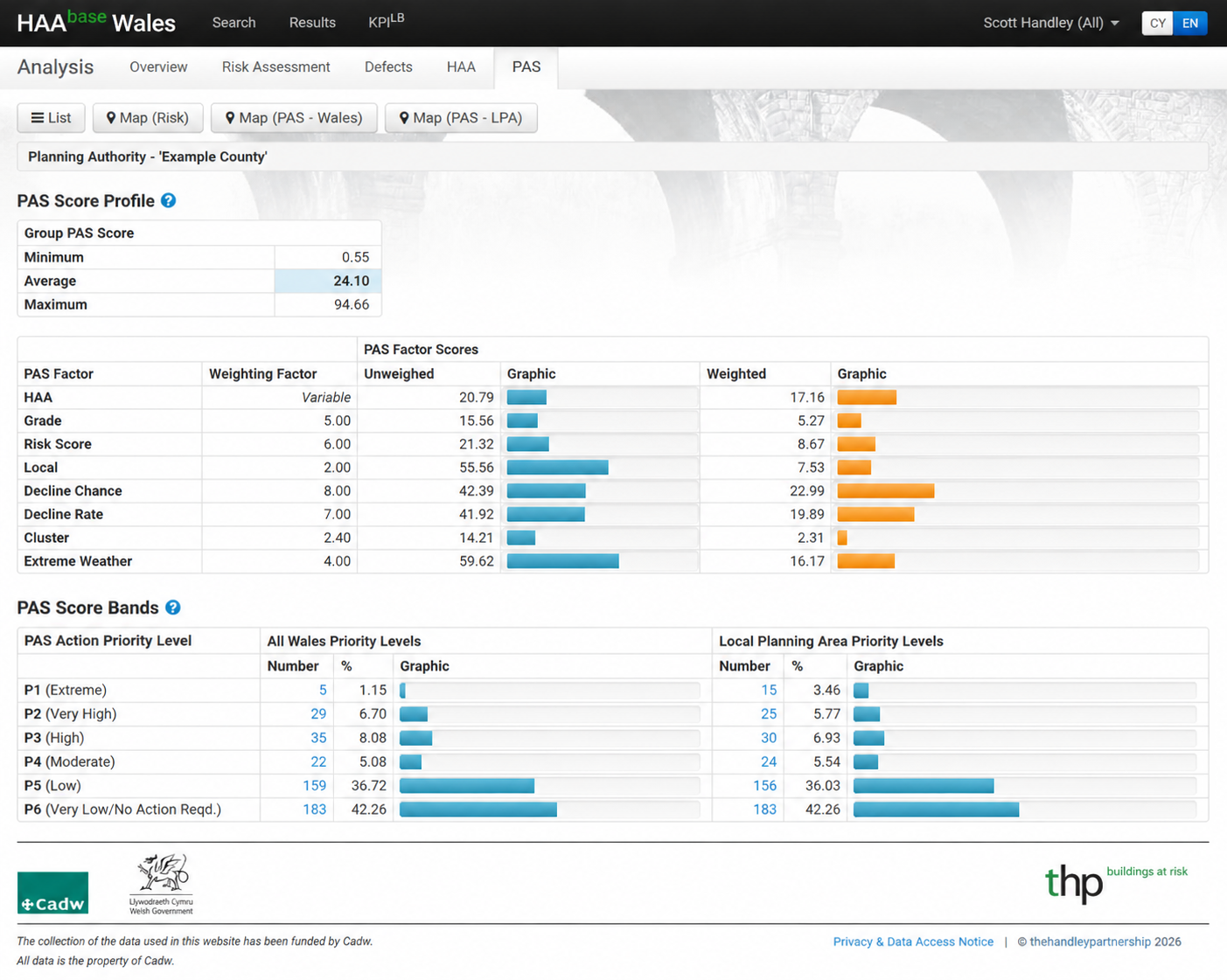 Prioritised action
Compare priority bands, weighted factors and local or national rankings.
Prioritised action
Compare priority bands, weighted factors and local or national rankings.
Experience
The Handley Partnership has delivered extensive listed building condition survey programmes across Wales and England, including county councils, unitary authorities, metropolitan boroughs and National Parks. The work includes repeated survey cycles, authority-wide inspections and programmes requiring longitudinal comparison over time.
HAABase has grown out of more than three decades of Buildings at Risk work, combining consistent external inspection, weighted assessment scoring and analytical modelling to support practical action rather than passive record keeping.
Major programmes include the All Wales Listed Building Condition Survey for Cadw / Welsh Government, involving more than 35,000 inspections, and a heritage building inspection programme in Winnipeg, Canada.
Related service
Alongside commissioned Heritage at Risk survey and assessment services, The Handley Partnership also develops specialist heritage registers and research-led datasets. This work includes structured record design, desk-based research, field recording, photographic evidence, mapping, search tools and public or private heritage data platforms.
Examples include HAABase Mines and HAABase Windmills, which demonstrate the wider HAABase approach to structured records, mapping, field evidence and long-term heritage data management.
View heritage register design servicesEnquiries
The Handley Partnership can help define the survey area, assessment method, delivery model, training needs, database structure, update process and final outputs. We can provide a complete Buildings at Risk survey, database and analysis service, or support your own surveyors with training, HAABase implementation and quality review.
Discuss a Buildings at Risk survey or HAABase project